Pour sa première exposition, Habba-Chajara-Zahra, au Musée Mohammed VI d’art moderne et contemporain, l’artiste Younès Rahmoun réactive deux installations vidéo célébrant le cœur sensible de l’univers et des croyants.
En ce mois sacré de Ramadan, le MMVI convie l’artiste Younès Rahmoun à présenter deux œuvres majeures invitant à une contemplation méditative du mystère de la création que chacun porte à l’intérieur de soi. Une première animation vidéo datant de 2008-2011, Habba (graine), fait ainsi voir la transformation d’une simple graine, perdue dans l’immensité de l’univers, donnant naissance à un arbre à sept branches dont les ramifications entrent en résonance avec l’infini cosmique. « À l’image du point en géométrie spirituelle soufie, [cette graine] porte en elle l’arbre, le ciel et la promesse d’un recommencement infini », écrit à ce propos Salima El Aissaoui, curatrice de l’exposition Habba-Chajara-Zahra. Mettant en avant l’importance du médium vidéo lui permettant de réunir le son, le temps et la lumière, Younès Rahmoun ajoute vouloir « montrer le rythme de la vie, de la mort à la renaissance, jusqu’à l’annonce de nouvelles vies dans le futur ».
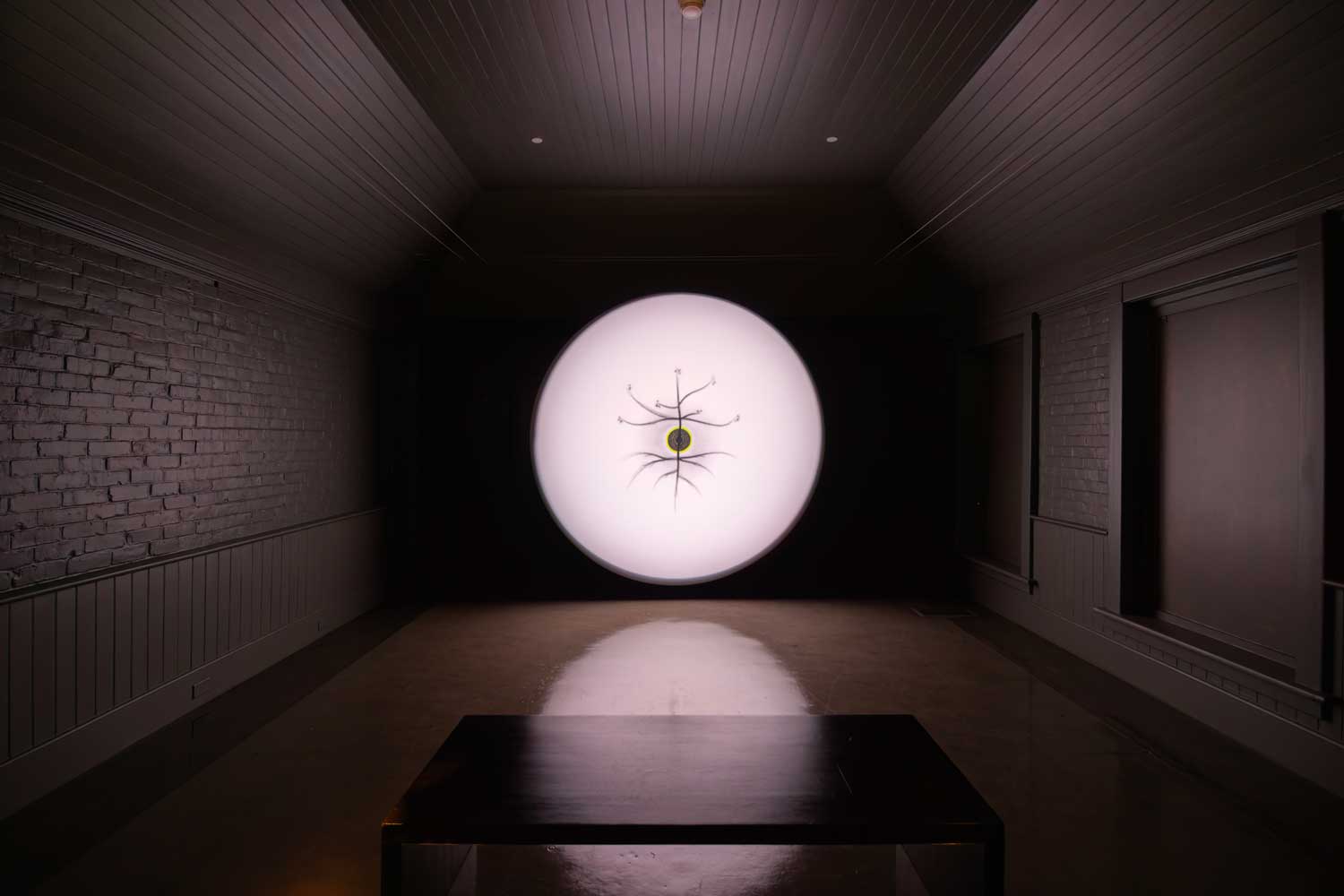
Mais le point d’orgue de cette exposition, consacrant l’un des artistes contemporains marocains les plus importants auquel le nouvel espace de Kulte Center for Contemporary Art & Editions consacrera prochainement à Rabat une rétrospective attendue, réside dans l’activation inédite de l’installation vidéo immersive Zahra-Khasla (fleur-vertu) conçue initialement en 2008 et déclinée aujourd’hui en dix écrans suspendus, accompagnés d’une création sonore hypnotique évoquant les pulsations du cœur humain. Au centre d’un halo lumineux, 77 fleurs, renvoyant pour l’artiste à un hadith évoquant les 77 branches de la foi, éclosent à partir d’un point rouge qui palpite ; moteur à la fois de la création et de la vie humaine qui n’en est que l’une des manifestations visibles.
Cette invitation à se recentrer sur les processus de germination à l’œuvre dans l’univers, à repenser/repanser les liens qui nous unissent au cosmos et à la Nature tout entière situe le travail exigeant et universel de Younès Rahmoun à sa juste dimension : « un art islamique contemporain affranchi de la tradition », selon les mots de la curatrice. « Ce que nous voyons projeté sur ces dix écrans, renchérit Nadia Sabri, directrice du MMVI, est la métaphore de l’éternel recommencement associé au cycle de la nature, et qui est parfaitement en miroir d’un cycle intérieur et intime, celui du cheminement spirituel qui s’accomplit aussi de façon cyclique ».
Olivier Rachet
Exposition Haba-Chajara-Zahra de Younès Rahmoun, Musée Mohammed VI d’art moderne et contemporain, Rabat, jusqu’au 30 mars 2026.
For his exhibition Habba–Chajara–Zahra at the Mohammed VI Museum of Modern and Contemporary Art, artist Younès Rahmoun reactivates two video installations celebrating the sensitive heart of the universe and of believers.
During the sacred month of Ramadan, the MMVI invites Younès Rahmoun to present two major works encouraging a meditative contemplation of the mystery of creation carried within each of us. The first video animation, dating from 2008–2011, Habba (Seed), shows the transformation of a simple seed, lost in the vastness of the universe, giving birth to a seven-branched tree whose ramifications resonate with cosmic infinity. “Like the point in Sufi spiritual geometry, [this seed] contains within it the tree, the sky and the promise of an infinite renewal,” writes Salima El Aissaoui, curator of Habba-Chajara-Zahra. Emphasizing the importance of video as a medium allowing him to unite sound, time and light, Younès Rahmoun adds that he seeks “to show the rhythm of life, from death to rebirth, and the announcement of new lives in the future.”
The highlight of the exhibition — consecrating one of Morocco’s most significant contemporary artists, to whom the new Kulte Center for Contemporary Art & Editions in Rabat will soon dedicate a long-awaited retrospective — lies in the unprecedented activation of the immersive video installation Zahra-Khasla (Flower-Virtue), originally conceived in 2008 and now presented across ten suspended screens, accompanied by a hypnotic sound composition evoking the pulsations of the human heart. At the center of a luminous halo, seventy-seven flowers — referring for the artist to a hadith mentioning the seventy-seven branches of faith — bloom from a pulsing red point, a motor of both creation and human life, of which humanity is only one visible manifestation.
This invitation to refocus on the processes of germination at work in the universe, to rethink and heal the bonds that unite us with the cosmos and with Nature as a whole, places Younès Rahmoun’s rigorous and universal practice in its proper dimension: “a contemporary Islamic art freed from tradition,” in the curator’s words. “What we see projected on these ten screens,” adds MMVI director Nadia Sabri, “is the metaphor of eternal renewal associated with the cycle of nature, perfectly mirroring an inner and intimate cycle — that of the spiritual path, which also unfolds cyclically.”
Olivier Rachet
Younès Rahmoun, Habba-Chajara-Zahra, Mohammed VI Museum of Modern and Contemporary Art, Rabat, until 30 March 2026.