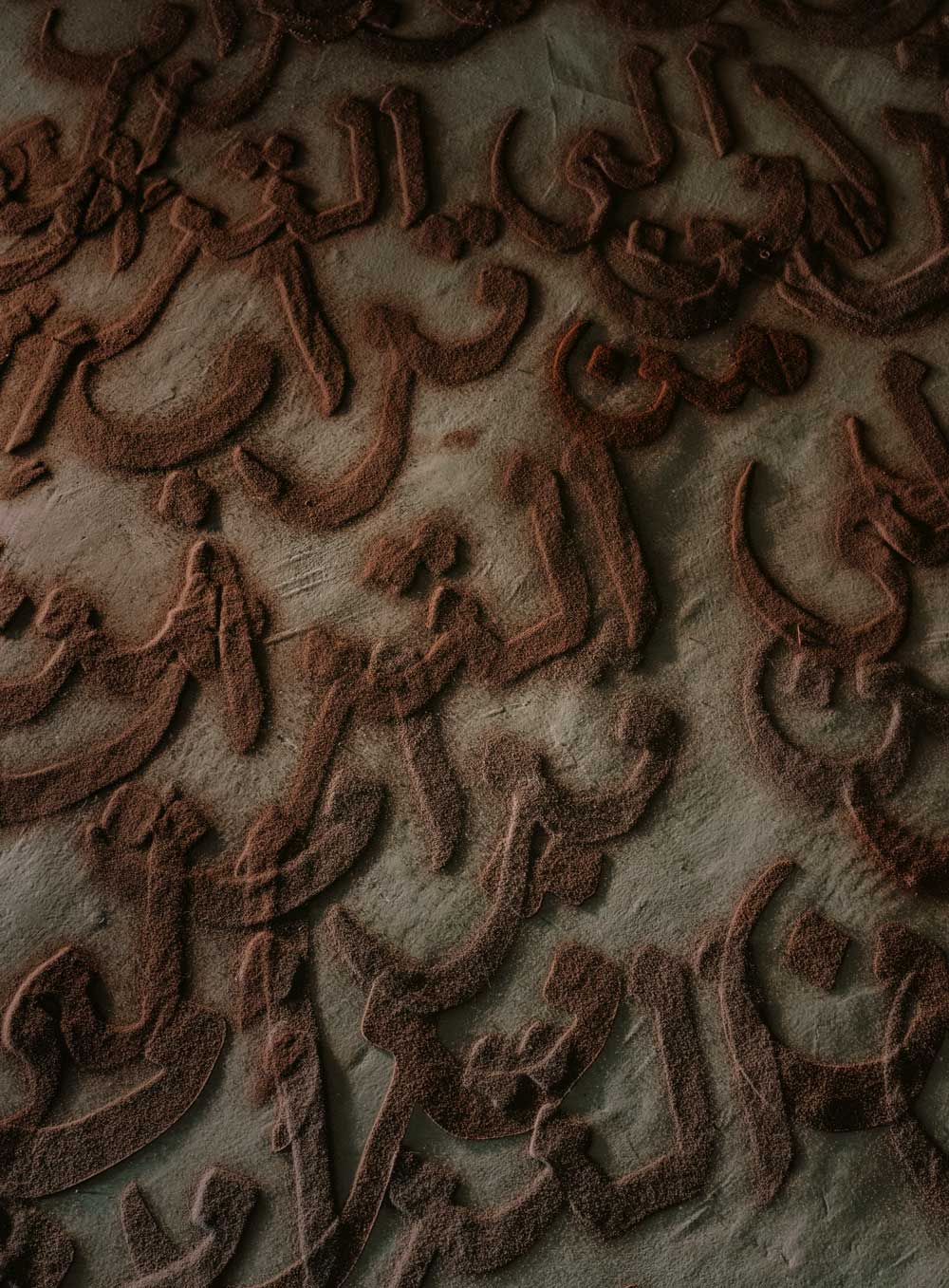
Au Macaal, l’installation de Fatiha Zemmouri Ilā Turāb, réalisée à même le sol, se distingue par son minimalisme et sa fragilité silencieuse.
La terre, l’un des matériaux de prédilection de l’artiste-plasticienne Fatiha Zemmouri, est au centre de l’installation Ilā Turāb (« à la terre »). À partir de celle issue de la région d’Al Haouz, notamment de Tahanaout où elle réside, mais aussi des débris de l’installation de Salima Naji Dans les bras de la terre présentée l’an passé dans l’atrium du musée, Fatiha Zemmouri écrit à même le sol, dans le style calligraphique diwani, deux phrases se superposant l’une à l’autre, dans une circularité invitant le spectateur à déambuler autour de l’œuvre.
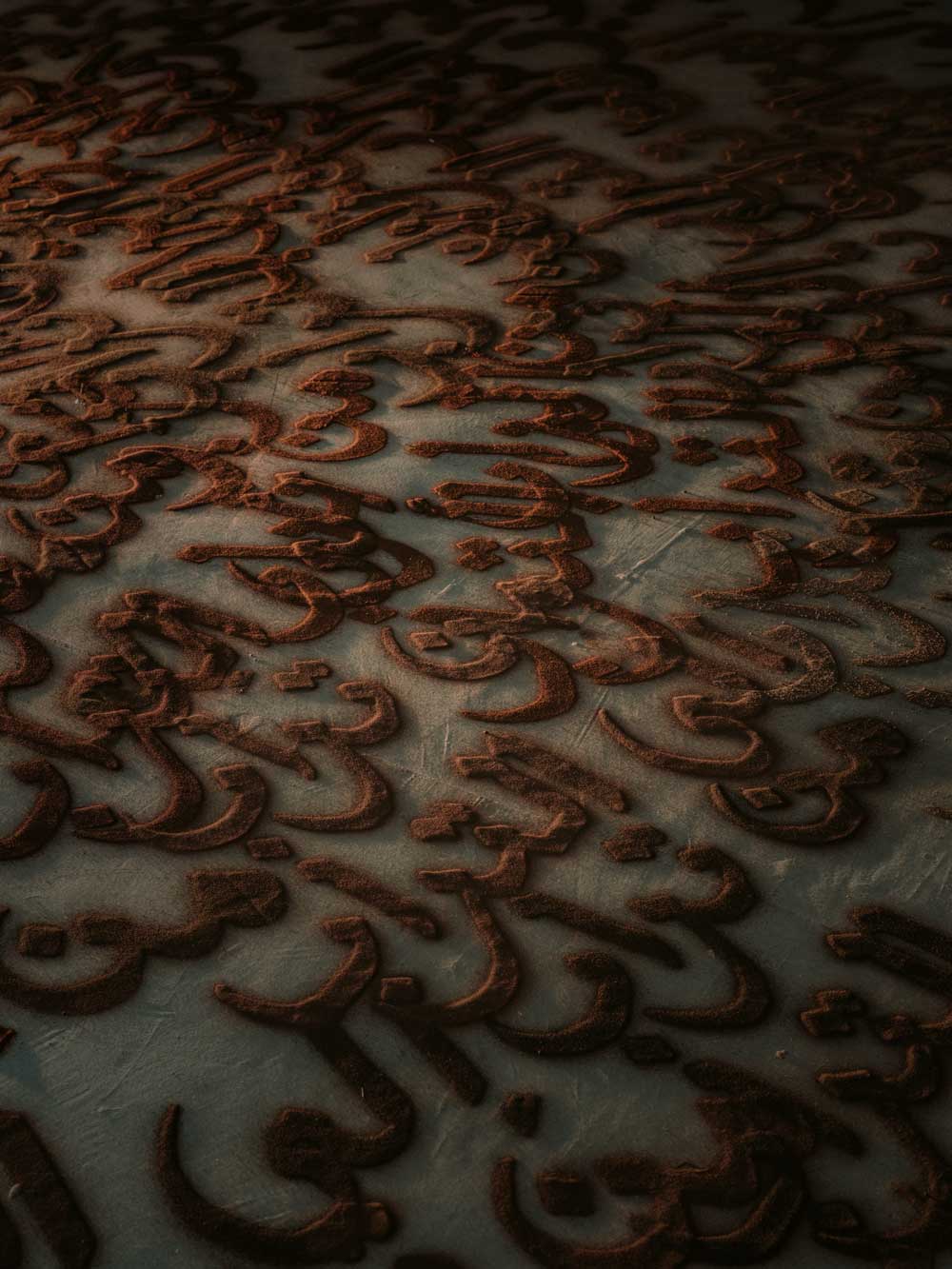
Inscrits à partir d’un pilier diffusant un éclairage rasant qui permet d’observer les aspérités du sol, ces énoncés « min turāb » (issu de la terre) et « ilā turāb » (à la terre), rendus d’abord illisibles, s’éclairent au gré d’un mouvement centrifuge qui n’est pas sans évoquer le cycle de la vie à la mort, et d’une renaissance toujours possible. Affranchie de toute religiosité, l’installation bloque néanmoins, par la proximité d’un mur, toute tentative d’effectuer un tour complet, obligeant le visiteur à un aller-retour réflexif.
Invitation à l’introspection et à une méditation silencieuse, Ilā Turāb fascine par sa fragilité, ses nuances de couleur et sa texture passant d’un velouté apaisant à une âpreté plus troublante. La terre d’où nous provenons et à laquelle nous retournerons devient son propre matériau d’écriture comme si la lettre, en l’occurrence ici une lettre marquée par la courbure de ses lignes, était aussi vivifiante que l’esprit. Promise à la disparition, cette installation éphémère, loin de toute monumentalité, nous confronte aussi à l’énigme de notre existence, ancrée dans un sol africain ; berceau de nos origines communes.
Olivier Rachet
Exposition Ilā Turāb de Fatiha Zemmouri, MACAAL, Marrakech, jusqu’au 19 avril 2026.
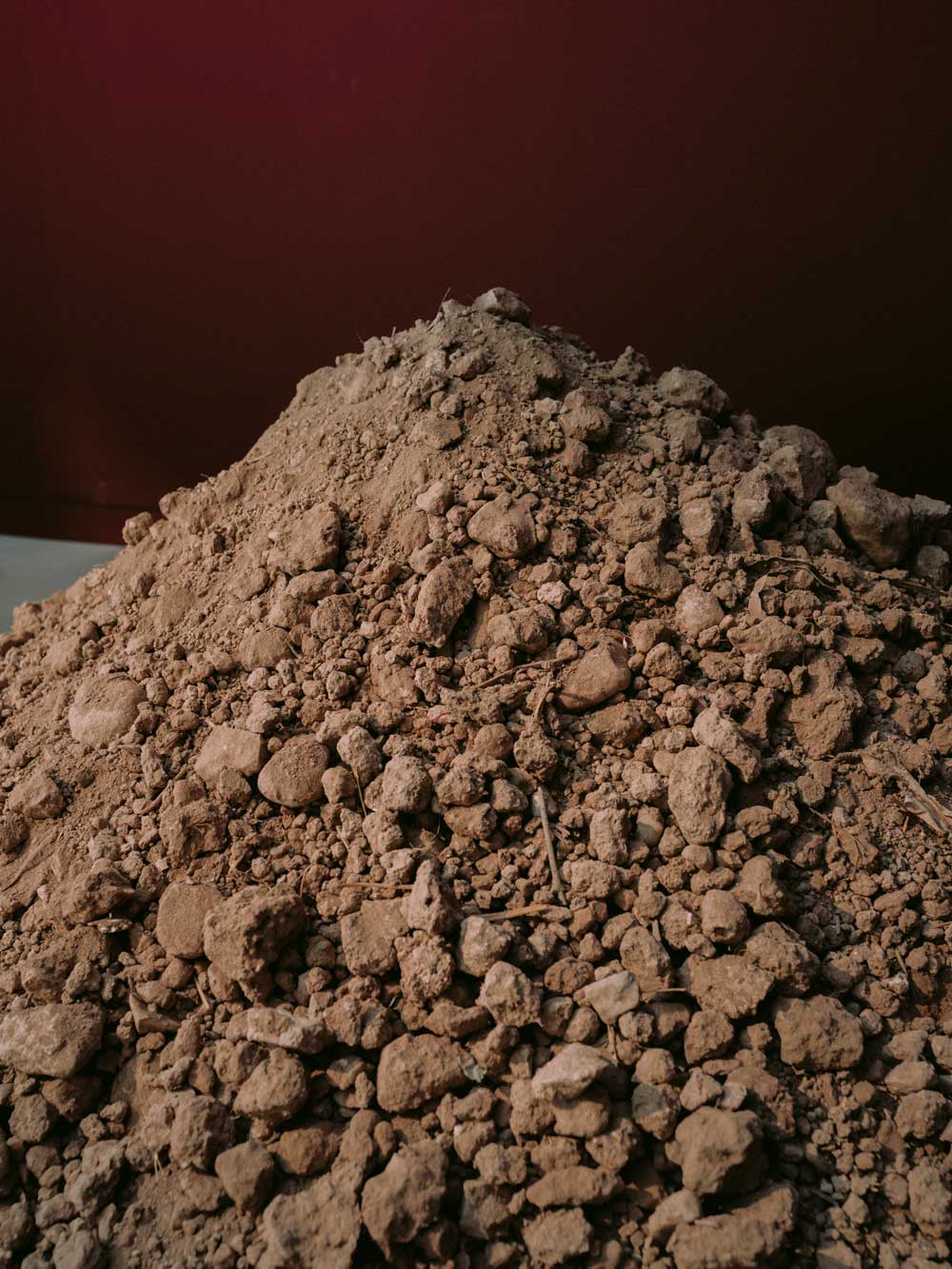
At MACAAL, Fatiha Zemmouri’s installation Ilā Turāb, laid directly on the floor, stands out for its quiet minimalism and understated fragility.
Earth, a material central to Zemmouri’s practice, forms the core of Ilā Turāb (“to the earth”). Drawing on soil from the Al Haouz region, particularly Tahanaout, where she lives, as well as remnants from Salima Naji’s installation Dans les bras de la terre, presented last year in the museum’s atrium, Zemmouri inscribes two overlapping phrases directly onto the ground in diwani calligraphy. Their circular arrangement invites viewers to move around the work.
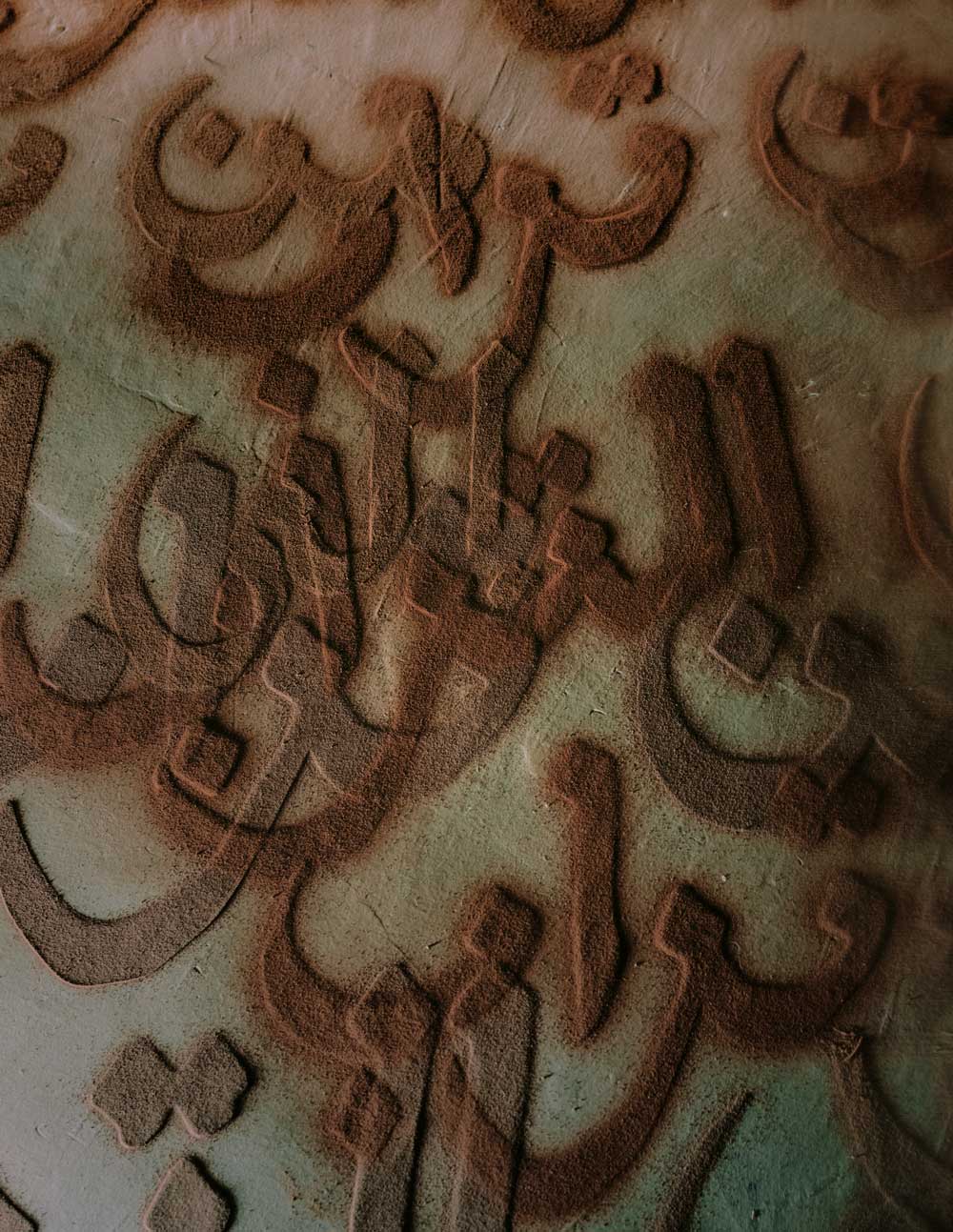
Radiating outward from a single pillar casting a low, grazing light that reveals the surface’s textures, the phrases “min turāb” (from the earth) and “ilā turāb” (to the earth) are initially difficult to read. They gradually emerge as the viewer moves, in a centrifugal motion that evokes the passage from life to death and the possibility of renewal. While free of overt religiosity, the installation subtly disrupts any attempt at a full circular path. A nearby wall interrupts the movement, prompting viewers instead into a reflective back and forth.
Both introspective and quietly contemplative, Ilā Turāb captivates through its fragility, its subtle shifts in tone, and its tactile quality, moving from a soft, almost velvety surface to a more abrasive texture. The earth, from which we come and to which we return, becomes here a medium of inscription, as if the written line, shaped by its curves, carried a life force of its own. Ephemeral and deliberately unmonumental, the installation confronts us with the enigma of existence, rooted in an African ground understood as the cradle of shared origins.
Olivier Rachet
Fatiha Zemmouri, Ilā Turāb, MACAAL, Marrakech, on view until April 19, 2026.